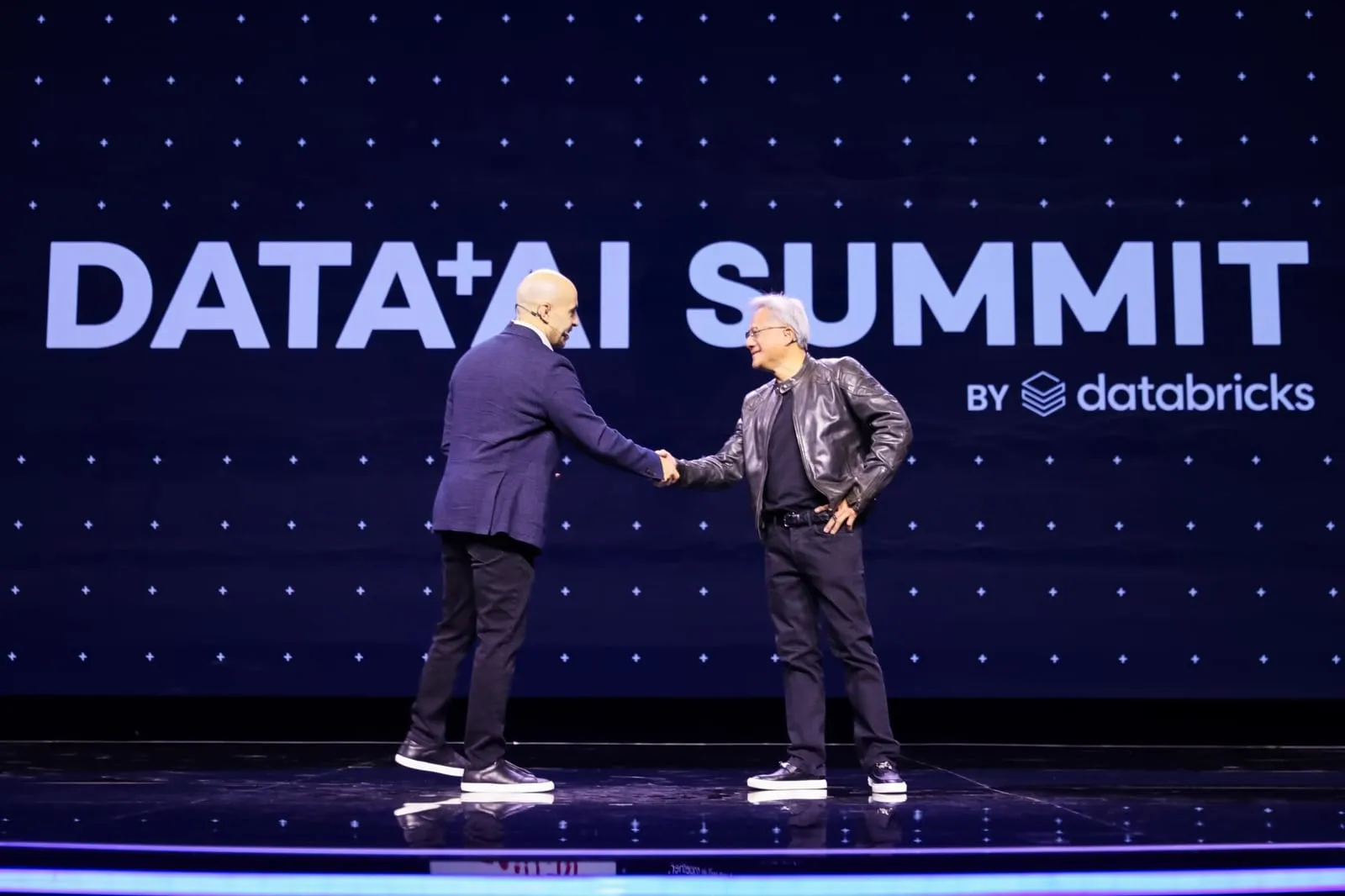
Databricks held its annual Data + AI Summit at the Moscone Center in San Francisco on June 15–18. The company expected more than 30,000 in-person attendees from 150+ countries, with tens of thousands more joining virtually, across a program of 800+ breakout sessions, an agentic-apps hackathon with OpenAI, and a closing concert by The Chainsmokers at Oracle Park. AINsf collects the main announcements from the conference here.
CEO Ali Ghodsi’s keynote thesis set the tone for the week: AI doesn’t have an intelligence problem, it has a context problem — models are smart enough, but they lack governed access to enterprise data. Guests on the keynote stage included OpenAI co-founder Greg Brockman, Microsoft CEO Satya Nadella (in a pre-recorded fireside chat), and PepsiCo’s global chief data and AI officer Magesh Bagavathi.
Genie One
The biggest launch of the summit was Genie One, an “agentic coworker” for business teams that is now generally available. It works across structured and unstructured data, connects to more than 50 apps including Google Drive, Salesforce, Jira, and Slack, and can produce documents, reports, and dashboards. It ships on web, iOS, Android, Teams, and Slack, with pay-as-you-go pricing and a free monthly token allocation of roughly $10 per user.
The Genie family also expanded with Genie Agents (turning conversations into reusable, governed agents), Genie Code (an agentic data and ML workspace that can import Tableau and Power BI workbooks), and Genie App Builder, a private-preview tool for building business apps from natural language.
Lakehouse//RT and a new query engine
On the infrastructure side, the company introduced Lakehouse//RT, a new real-time SQL warehouse type that queries Delta and Iceberg tables directly with sub-100ms latency at 12,000 queries per second — co-founder Reynold Xin called it the company’s largest single innovation since the lakehouse itself. It is powered by Reyden, a new query engine trained on trillions of real query workloads. Databricks also previewed LTAP, an architecture that unifies transactional and analytical processing on a single governed copy of data, and made Lakebase, its serverless Postgres offering, generally available with cross-cloud disaster recovery.
Agents, governance, and open sharing
Agent Bricks, launched at last year’s summit, has now been used to build more than 100,000 agents, and gained multi-framework support (including the Claude Code SDK, OpenAI Agent SDK, LangGraph, and CrewAI), managed agent memory, and document intelligence. Unity Catalog added the Unity AI Gateway for runtime governance of models, agents, and MCP servers, with hard spend caps and prompt-injection guardrails.
Ahead of the summit, Databricks also announced OpenSharing, an open, vendor-neutral evolution of Delta Sharing hosted by the Linux Foundation — the first open protocol for sharing AI assets such as agent skills and models across platforms, including to Snowflake.
Security became a bigger storyline too: Databricks announced its intent to acquire Panther, an AI-native security operations platform whose customers include Anthropic (terms undisclosed — its third security acquisition), and made Lakewatch, its agentic SIEM built on the lakehouse, generally available.
Finally, the company expanded its Free Edition, which has passed 500,000 users: Genie Code, serverless GPUs, Lakebase, Agent Bricks, and Lakeflow Designer are now all available at no cost.