
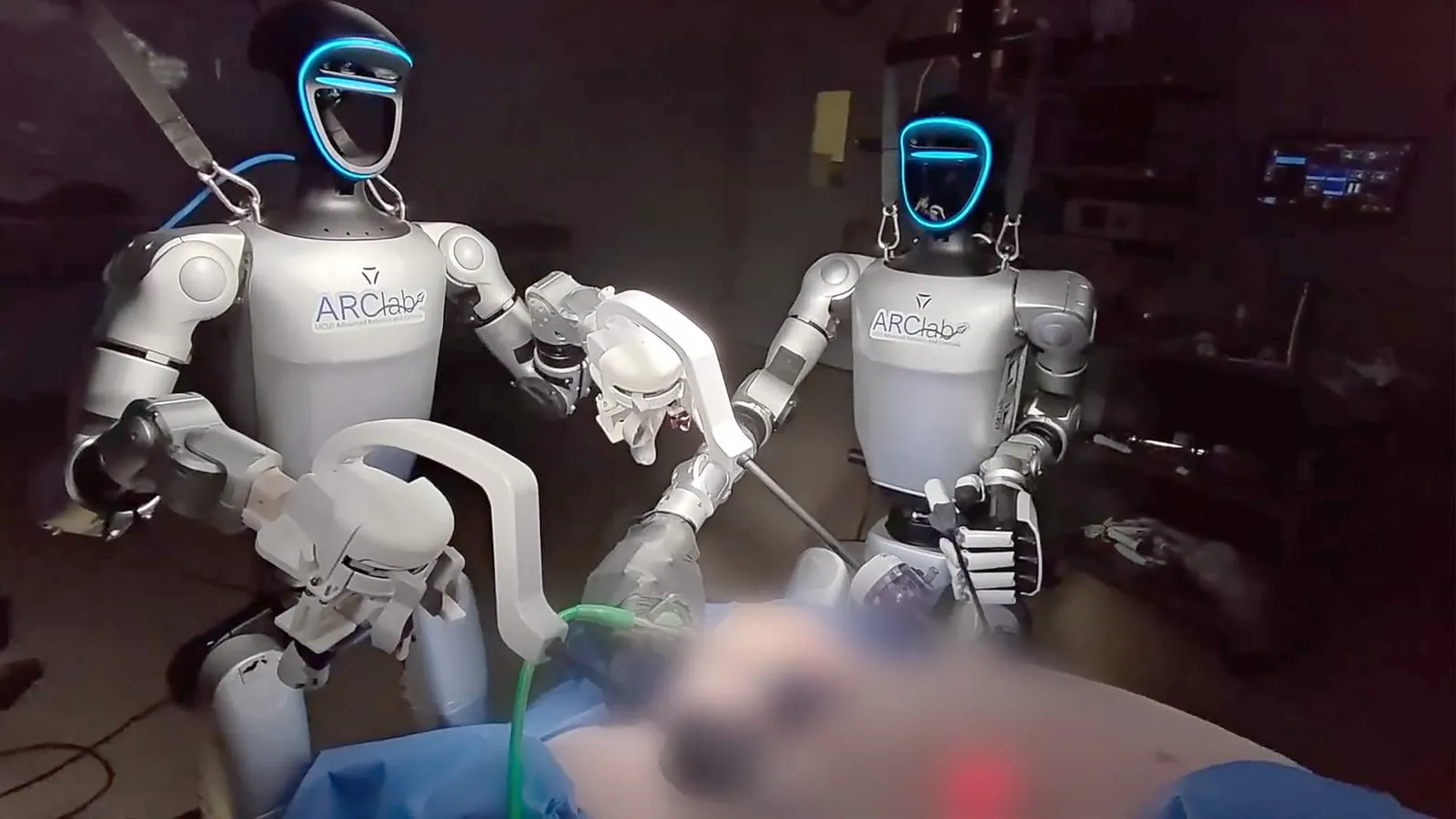
For the first time, teleoperated humanoid robots have completed live surgeries. In a preclinical trial described in the journal Nature this July, a team of engineers and surgeons at the University of California San Diego used general-purpose humanoid robots to perform two laparoscopic gallbladder removals on pigs — a milestone that moves humanoid machines from demo videos into the operating room. AINsf explains what happened and why it matters.
Two surgeries, two configurations
The team ran the experiment in two setups. In the first procedure, a humanoid robot handled the surgical instruments while a human surgeon assisted beside it. In the second, two humanoid robots stood side by side and completed the operation as a robot-robot team. In both cases the robots were teleoperated: surgeons at a remote console made the movements, and the robots mirrored them at the table — the machines made no medical decisions of their own. The robots retracted tissue, dissected around the gallbladder, and helped place clips before removal.
Robotic gallbladder surgery is routine — what’s new is the hardware. Instead of a specialized surgical system, the researchers built their robot, nicknamed Surgie, from commercially available Unitree G1 humanoids, which sell for around $13,500 before add-ons. Each Surgie stands about 5 feet (1.5 m) tall and weighs roughly 60 pounds (27 kg), with hand adapters that let it grip standard laparoscopic instruments. Conventional surgical robots weigh around 1,800 pounds, cost from hundreds of thousands of dollars to over $3 million, and often require retrofitting the operating room around them. Surgie simply stands in a room built for people.
Why the researchers are doing this
The target problem is the global shortage of surgeons and the backlogs it creates, especially in rural and under-resourced regions. A compact, mobile robot that uses ordinary instruments could someday let a remote specialist operate in a small clinic or field hospital that could never justify a multimillion-dollar installation. Professor Michael Yip of UC San Diego’s engineering department, a co-author of the study, described the goal as an operating theater where humans and humanoid robots work “side by side as an integrated team.” Because the robot can walk, the team also sees it fetching instruments and tidying the room between procedures.
The honest caveats
The researchers are upfront that this was a proof of concept, not a product. The robots had to be recalibrated several times mid-surgery, the procedures took much longer than with established systems, and latency — the lag between the surgeon’s hand and the robot’s — remains a challenge for any remote operation. The team points out that early specialized systems had the same growing pains: the first robotic laparoscopic surgery took six hours, while today the same procedure takes about 30 minutes. Human trials remain some way off, and the harder questions — who is accountable when an autonomous assistant errs, what happens if the connection drops — will need answers before then.
Still, the direction is clear. The same week this study made headlines, a full-size humanoid completed the first 11-vs-11 robot soccer match in South Korea, and commercial humanoids entered restaurants and warehouses on subscription plans. The machines are leaving the lab.